
How a gossan forms
Many metal deposits are made of sulphide minerals: pyrite, chalcopyrite, sphalerite, galena. These are stable at depth but not at surface. Where rain and oxygen reach them, they oxidise. Pyrite in particular produces sulphuric acid as it breaks down, and the acid attacks the minerals around it.
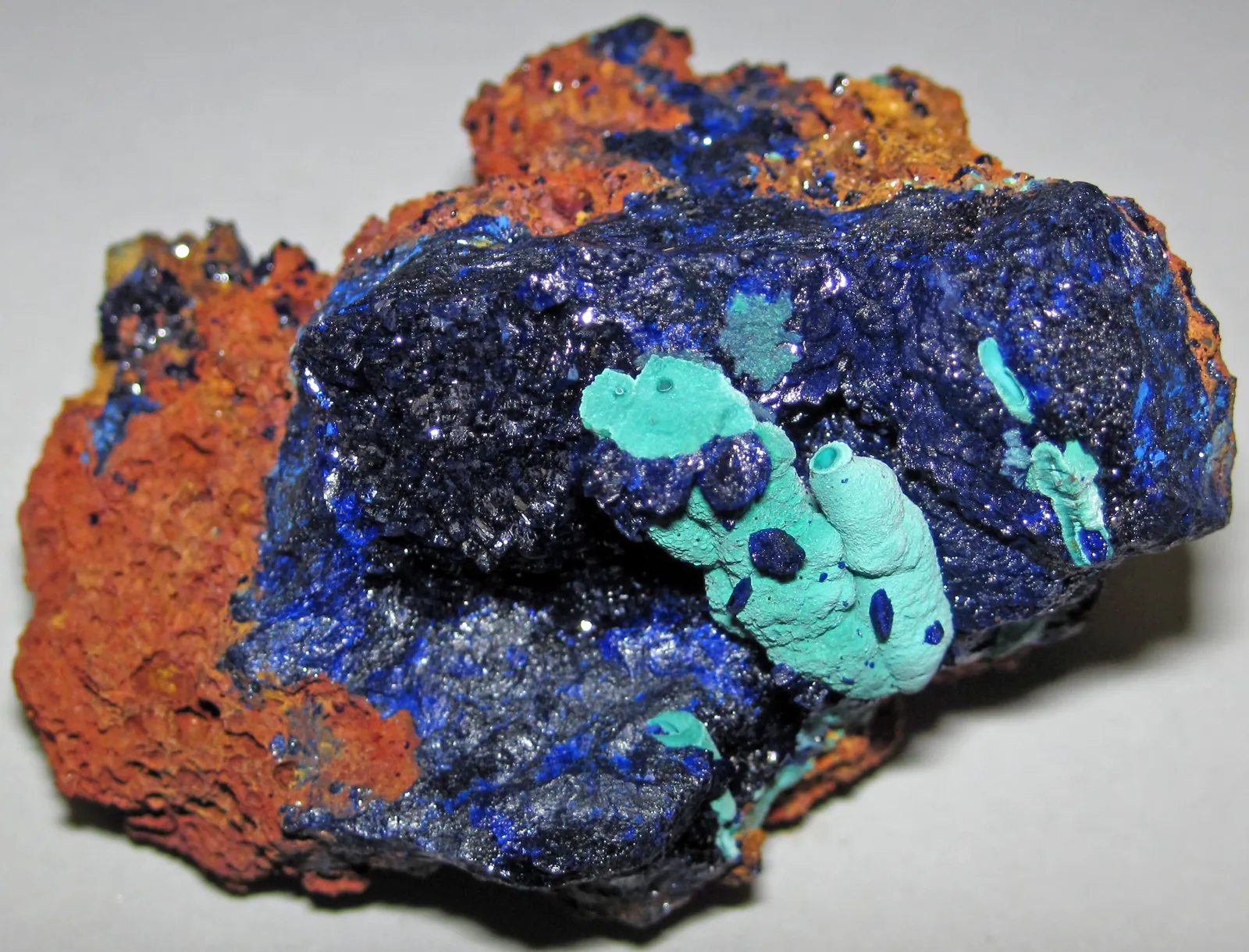
Copper, zinc and other mobile metals dissolve and are carried downwards by the acid water. Iron behaves differently. It falls out of solution almost at once as oxides and hydroxides, mainly goethite and hematite, often with the yellow sulphate jarosite. What stays at surface is a porous, rust-coloured mass of iron minerals and silica: the gossan, also called an iron cap. The word comes from Cornish mining.
What lies beneath
A weathered sulphide body usually has a vertical order. At the top is the gossan and a leached zone from which most metal has been removed. Lower down, around the water table, some of the dissolved metal can be deposited again. In copper systems this supergene zone may be richer than the original rock, with minerals such as chalcocite coating the primary sulphides. Below it lies the unweathered primary mineralisation.
This is why a gossan matters to an explorer and also why it can mislead. The rock at surface may hold almost none of the metal of interest, while the same system carries it tens of metres down.
Reading a gossan
Geologists have long tried to tell from the cap what was there before weathering. Three kinds of evidence are used.
- Texture. When a sulphide grain dissolves, the iron oxide deposited along its cracks can keep the outline of the grain as a cellular “boxwork”. Different sulphides leave different boxwork patterns.
- Colour and mineralogy. The proportions of goethite, hematite and jarosite reflect how acid the weathering was, and so how much pyrite the rock held.
- Chemistry. Some elements stay behind when the main metals leave. Lead, arsenic, antimony, bismuth, gold and silver tend to remain in the cap and act as pathfinders for what was leached.
Not every gossan sits above ore
Iron-rich rocks at surface are common and most are not above a deposit. Barren pyrite weathers to a perfectly good-looking gossan. Lateritic ironstones, ferruginous sediments and iron-stained fault zones can all look similar in the field. These are sometimes called false gossans.
The opposite error also happens. A deposit can lie under transported cover, with no gossan at all, or under a cap so leached that it carries no visible sign of copper or zinc. Climate matters too: deep, old weathering profiles in arid and tropical regions behave differently from thin ones in recently glaciated ground.
Gossans in modern exploration
Prospectors once found gossans by walking. Today they are also mapped from satellite images, because iron oxides and the clay minerals around them have distinctive spectral signatures. That makes it cheap to find many candidates and correspondingly important to sort them.
Sorting is a matter of combining evidence: the chemistry of the cap, the geology and structure around it, and what geophysics says about the rock below. A gossan with pathfinder elements, sitting on a mapped structure over a geophysical anomaly, is a different proposition from an iron-stained outcrop with none of these. That step, from a visible sign to a ranked target, is described under prospectivity analysis and drill targeting.
Why the name
Gossan takes its name from this rock: the part of a mineral system that can be seen at surface, and that has to be read with care before anyone commits to drilling beneath it.
_(27890565095).jpg)